Agenda: the implementation plan for the Energy Strategy; the introduction of scientific and technological advances in the agro-industrial complex; and support for the fisheries sector.
Excerpts from the transcript:
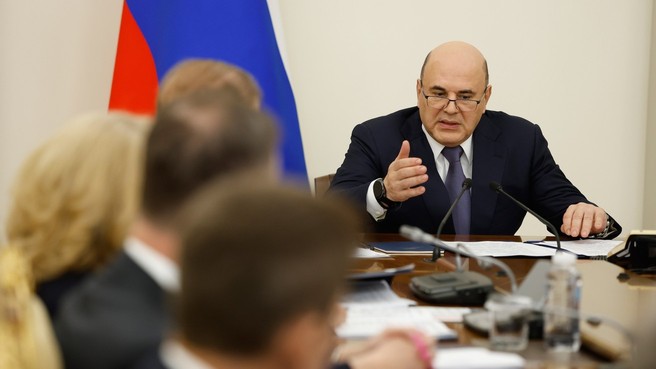
Meeting with Deputy Prime Ministers on current issues
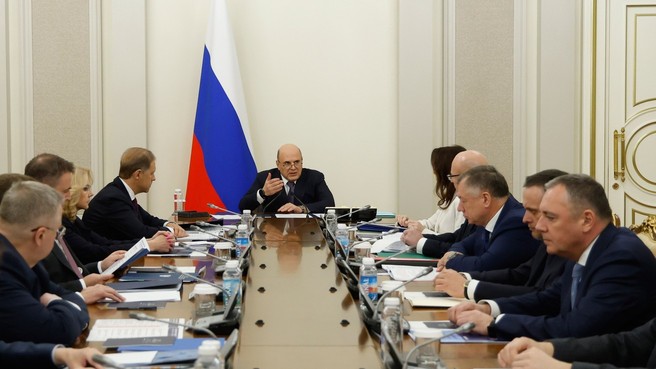
Meeting with Deputy Prime Ministers on current issues
Meeting with Deputy Prime Ministers on current issues
Mikhail Mishustin: Good morning, colleagues.
The energy sector continues to play a vital role in our economy. The Government is working systemically to develop it. To address long-term challenges, the Energy Strategy has been updated on the President’s instructions, extending its planning horizon to 2050.
An implementation plan has now been drawn up, covering the first stage – the next three years. It will enable us to continue adapting to various challenges and ensure that we meet the national goals set by the President.
Our main priorities will be to maintain the reliability of Russia’s energy supplies and further develop and modernise the sector through the introduction of efficient technologies, infrastructure development and increased domestic production of both components and the equipment we need. We will also seek to optimise the use of resources at every stage, from extraction to processing.
We will gradually establish the conditions needed to adopt innovations and promote so-called smart energy through digitalisation, automation, reductions in harmful emissions and ф wider use of clean energy production methods. The share of alternative and renewable energy sources will also increase, alongside traditional oil and gas.
In international cooperation, we will continue to strengthen Russia’s position in global markets, deepen engagement with friendly countries, and promote our goods and services.
The Strategy also places particular emphasis on human resources policy, including the training and subsequent support of young professionals, talented scientists and engineers.
All these steps will lay the foundations for addressing long-term challenges and create the conditions for our economy to develop ahead of the curve, while preserving Russia’s role as a leading supplier in the global energy market.
Moving on to another topic: the introduction of scientific and technological advances in the agro-industrial sector.
We have made significant progress in many areas, including plant breeding and genetics, livestock breeding, and shortening the time it takes to bring new varieties and hybrids to market. We discussed these issues in detail with agricultural producers at the Golden Autumn exhibition just recently.
The President has emphasised that this is one of the key priorities for the economy as a whole and for agriculture in particular. He has set the target of ensuring that at least 75 percent of the seeds of major agricultural crops used by farmers are of domestic breeding. This year, we have come close to reaching 70 percent.
Taking into account the sector’s needs, we have prepared amendments to the State Programme for Agricultural Development. The Government will support agricultural producers investing in comprehensive research and technology projects. More than 50 such projects are currently underway, and all of them will be eligible for reimbursement of part of their costs. This state support will now cover not only the production of elite seeds, but also the purchase and sowing of seeds of domestically bred agricultural crops.
The draft federal budget for next year provides for allocating about four billion roubles to achieve these objectives.
The new rules will take effect on 1 January 2027. This will enable agricultural producers to make greater use of scientific developments and expand the production and use of seeds from domestic varieties. It will also help ensure that farmers have everything they need to continue achieving good harvests.
Another issue is support for the fisheries sector. An important part of its modernisation is monitoring the state of aquatic biological resources through the state information system. It also involves the widespread use of digital platforms to process information required by fishing fleets and other industry enterprises, enabling users to access government services quickly.
The President has noted that the sustainable development of the state and society depends to a large extent on the active adoption of digital technologies. The Government is consistently supporting this effort, including by promoting the use of home-grown solutions.
To improve the reliability of information systems in the fisheries sector, we will allocate funding to upgrade the infrastructure and purchase the necessary Russian-made equipment.
We expect this to ensure the uninterrupted operation of digital platforms and help improve the efficiency of fishing enterprises.