Mikhail Mishustin: “Nine major national projects are being implemented at a rapid pace. We are consistently building a fully-fledged ecosystem – from scientific research to the launch of large-scale series production and the delivery of finished products to consumers. The three-year federal budget provides a total of around two trillion roubles for these purposes.”
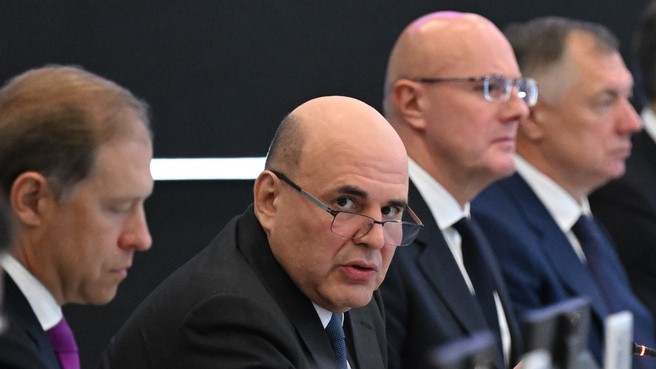
Mikhail Mishustin holds strategic session on the implementation of national technological leadership projects
Mikhail Mishustin’s opening remarks:
Good afternoon, colleagues.
Today we will continue our discussion of a broad range of issues and decisions aimed at strengthening the industrial sector. This sector is the foundation of our country’s development and the basis for improving our citizens’ quality of life.
The President has identified technological leadership as one of the key national goals. It is important not only to achieve independence in industries of critical importance to the economy, but also to create opportunities for the establishment of entirely new markets for breakthrough domestic developments.
To this end, nine major national projects are being implemented at a rapid pace, and the necessary funding has been allocated to each of them. The three-year federal budget, which is being prepared for its first reading in the State Duma, provides a total of around two trillion roubles for these purposes.
I would also note that the Russian regions will allocate funds to implement the planned activities. We expect that business investment will make a substantial contribution to our common cause.
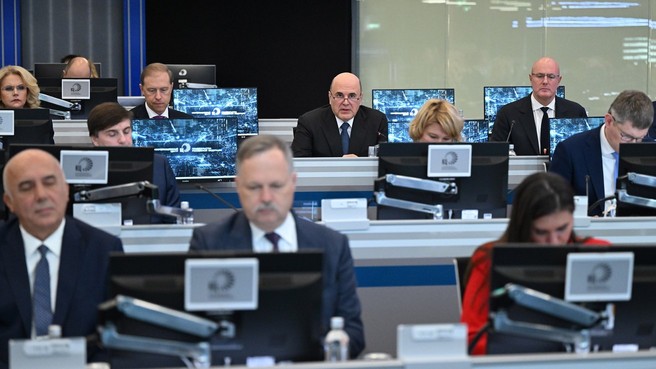
Mikhail Mishustin holds strategic session on the implementation of national technological leadership projects
It is crucial that the measures being taken are already delivering concrete results. Today we will look in more detail at some of these areas, first and foremost the New Nuclear and Energy Technologies project, where the production of equipment for the fuel and energy sector is being scaled up rapidly. The volume of this production has now reached almost a trillion roubles.
Particular attention is being paid to the innovation infrastructure of the nuclear industry. For example, a fast neutron reactor plant is being built in the Tomsk Region. Meanwhile, its full-scale training simulator was launched earlier this year at the Siberian Chemical Combine site.
Extensive work is also underway within the New Materials and Chemistry sector. In the first half of the year alone, 12 initiatives with a combined value of around 10 billion roubles were brought to completion.
In particular, in the Sverdlovsk Region, an enterprise manufacturing special components – foundry binders and novolac resins – has commenced operations. These components are used in a number of industries, including metallurgy, the automotive industry and the electronics industry.
Another area is Means of Production and Automation. Some 130 projects have received state support. This primarily involves the design of machine tools and robotic systems for the most promising fields, such as aircraft manufacturing, which is of vital importance. As a result, domestic units for applying heat-shielding coatings to turbojet engine blades are already in use, as is a five-axis machining system for composite wing panels for the flagship MC-21 airliner. Domestic automated machines for joining aircraft panels have also been deployed.
Since January, support mechanisms have also been fully operational for the technological development of the bioeconomy. These are already contributing to an increase in the output of products based on animal and plant raw materials. Exports of these products are growing as well.
There are achievements in other strategic areas as well. We will examine the progress in those areas in detail separately, at another strategic session.
To ensure the successful implementation of all these national projects, unified approaches have been developed so that every action over the planning horizon is clearly synchronised with the expected result.
To this end, the existing legal and regulatory framework is currently being improved. Among other things, we are enhancing the role of general designers and qualified customers, and we are updating the matrices of corporate cooperation.
Thus, we are consistently building a fully-fledged ecosystem – from scientific research to the launch of large-scale series production and the delivery of finished products to consumers.
Colleagues,
Our main shared goal is to maintain a sustained growth momentum. To do this, we must use all the instruments of state technology policy as effectively as possible.
Today I suggest that we assess the pace of work, current challenges and risks, and take additional decisions to strengthen domestic industry and provide citizens with high-quality and affordable goods.