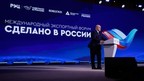
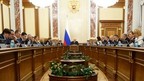
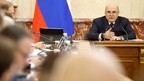
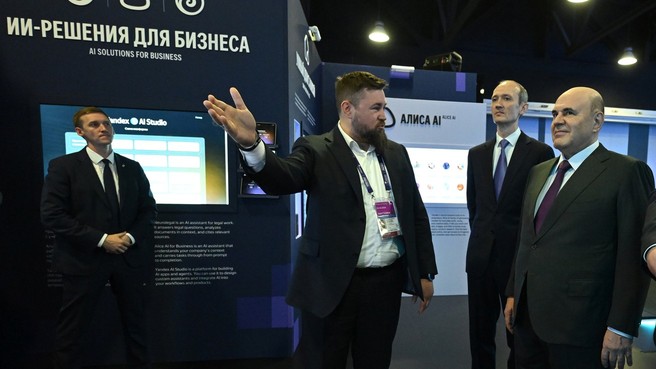
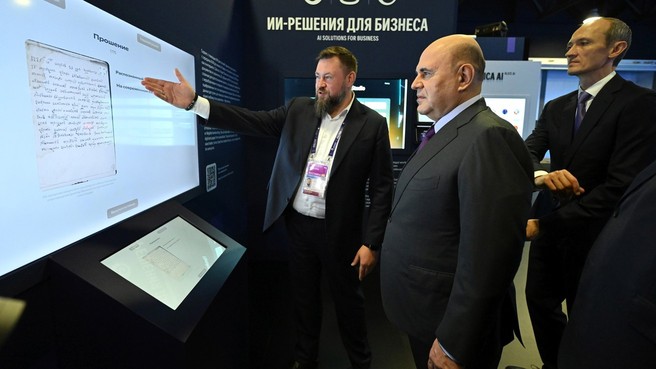
The main plenary session titled Results. Opportunities. Prospects. Before the session, Mikhail Mishustin visited the forum’s exhibition.

Mikhail Mishustin visited the exhibition of the Digital Solution Forum
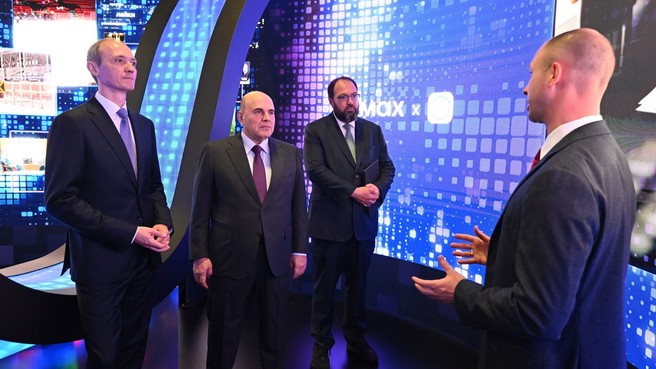
Mikhail Mishustin visited the exhibition of the Digital Solution Forum
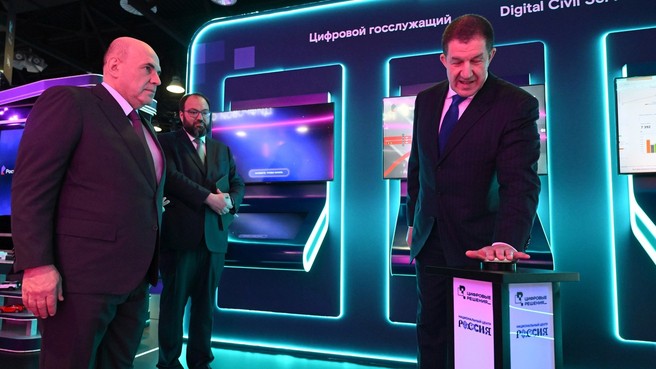
Mikhail Mishustin visited the exhibition of the Digital Solution Forum
Mikhail Mishustin visited the exhibition of the Digital Solution Forum
Mikhail Mishustin visited the exhibition of the Digital Solution Forum
Mikhail Mishustin’s remarks at the main plenary session of the Digital Solutions Forum
Mikhail Mishustin’s remarks at the main plenary session of the Digital Solutions Forum
Mikhail Mishustin’s remarks at the main plenary session of the Digital Solutions Forum
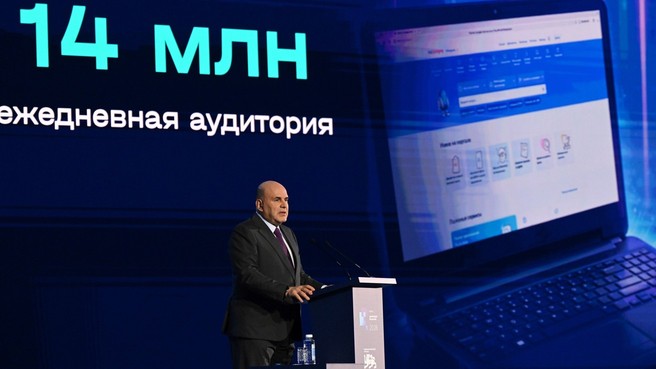
Mikhail Mishustin’s remarks at the main plenary session of the Digital Solutions Forum
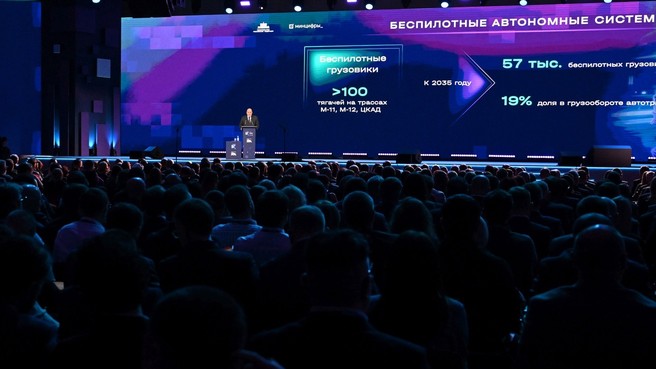
Mikhail Mishustin’s remarks at the main plenary session of the Digital Solutions Forum
Mikhail Mishustin visited the exhibition of the Digital Solution Forum
Remarks by Prime Minister Mikhail Mishustin
This is the second annual Digital Solutions IT Forum, which brings together representatives of the authorities, business and expert community for discussing case studies of digital technology implementation.
During the plenary session titled Results. Opportunities. Prospects, the heads of Russia’s leading IT and telecom companies will speak about their companies’ performance this year, best projects and plans for the future. The participants will discuss the next stage of digital transformation, which provides for transitioning from individual solutions to system-wide changes that will create new opportunities for the economy, business and people.
The forum’s programme also includes panel discussions on digital infrastructure, artificial intelligence, digital platforms and cybersecurity. Overall, there will be over 120 sessions and over 700 speakers.
The Digital Solutions exhibition will feature the partners’ solutions for the digital transformation of the state, business and social sphere, in particular, AI and machine learning solutions, digital platforms and services, corporate software, computing and data centres, telecommunication and network infrastructure, cybersecurity, navigation, and communications. Special zones will be devoted to public services and start-ups. The forum’s partners will display their products and projects at 26 stands.
Excerpts from the transcript:
Mikhail Mishustin: Colleagues and friends, good afternoon.
I welcome all participants in the Digital Solutions IT Forum.
It is being held at the Russia National Centre for the second time, bringing together representatives of the authorities and business, developers and clients, who are contributing to the strengthening of the national digital industry.
It is a strategic task that demands our utmost attention, including for achieving the national development goals approved by the President, as well as for improving the quality of life for our people.
A year is a long time in the digital industry. A great many things change during this period. Overall, the digital environment is a crucial part of the national economy. The aggregate turnover of our digital companies exceeded 21 trillion roubles last year, growing by nearly 20 percent.
The forum offers a good opportunity to review the results we have achieved and identify elements that require continued joint efforts of the state, businesses, developers, engineers and scientists.
I will speak about the key elements of our common work.
One of them is the further development of the national telecommunications industry. Last year, the market of communication services increased by 13 percent and reached 2.5 trillion roubles. The number of base stations increased by nearly 9 percent and reached 1 million stations.
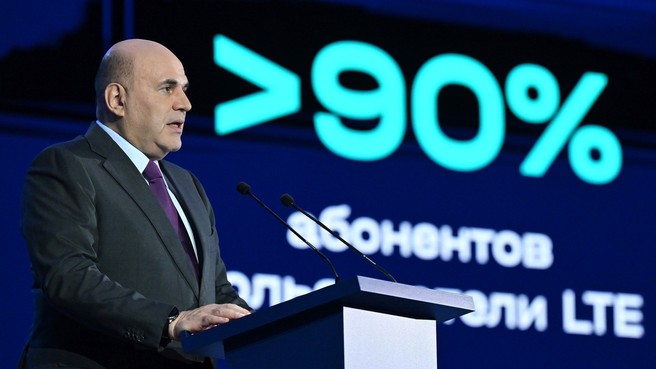
4G networks cover virtually all households.
At the President’s initiative, we are implementing a programme to eliminate digital inequality so that all our citizens have access to quality communications even in the outlying regions of our vast country. Over the past six years, the LTE mobile internet service has been made available to people in 8,000 small settlements, and more than 1,500 populated areas will gain access to it this year.
In September, we launched G5 networks on instructions from the head of state, initially on active LTE frequencies. The required additional bands have been allocated to all the Big Four operators free of charge.
To ensure the operation of the new communications standard in Moscow, St Petersburg, Yekaterinburg and a dozen other large cities, we must accelerate transition to national equipment in this sphere. Our enterprises are slowly but surely solving this problem. Three companies have produced over 10,000 base stations. We should start laying the groundwork for next-generation networks. I am absolutely confident that our national developers and producers have the capability to do this.
The fixed broadband segment is rapidly developing. It has grown by nearly 25 percent over the year.We are promoting large-scale fibre communications projects. For example, in the remote areas of the Arctic Yakutia and along the Northern Sea Route, from the Murmansk Region to Vladivostok.
We have just toured the exhibition. Rostelecom presents new high-speed backbone lines running through entire Russian territory from the west to the east, all the way to the borders with Mongolia and China. The project is supported by the VEB.RF project finance factory. People and businesses will get a stable uninterrupted internet and, most importantly, the data transfer speed at extremely long distances will be increased.
In view of the continuously growing traffic, it is necessary to create additional stimuli to guarantee investment from internet service providers into a modern gigabit infrastructure for competitive connection in residential buildings.
Notably, our engineers, innovators and inventors do not limit their work to ground infrastructure. Currently, there is a group of over 30 low-orbit satellites that will provide high-speed internet in any part of the country.
Testing railway satellite terminals will begin soon. This technology will allow passengers and crews to stay online throughout the journey.
All telecommunication initiatives will significantly expand electronic service access for the public and businesses, driving other sectors forward. We expect the number of such projects to grow.
A strong telecommunication industry is one of the infrastructure pillars of the digital economy along with a developed network of data centres. To build this network is another joint task for the state and businesses.
Cloud technology is no longer an auxiliary service that comes with data centres. It has become a primary offer. Providers already earn 80−90 percent of their sales revenue from cloud services, and this share will only be growing.
There are currently 42 data centres under construction, with investment exceeding 280 billion roubles.
The President has instructed to create a master map for these facilities. We should prioritise territories with electric energy surplus, where there are NPPs or HPPs.
Data centres are also necessary today for artificial intelligence tasks. Countries claiming leadership in AI are consistently restricting the transfer of key technology thus exacerbating other states’ dependence on their solutions. We must not allow a similar scenario for ourselves. Therefore, supporting and developing our own technology is a matter of national competitive ability and Russia’s digital sovereignty.
Russia remains in the race of major foundation models – we have several of them. Russian engineering teams have achieved truly impressive results.
Of course, we will continue to promote conditions for the development and application of such innovative technology in Russia.
The President has stressed the importance of adjusting regulation, to make sure that it stimulates expedited development and implementation rather than stalls and hinders it.
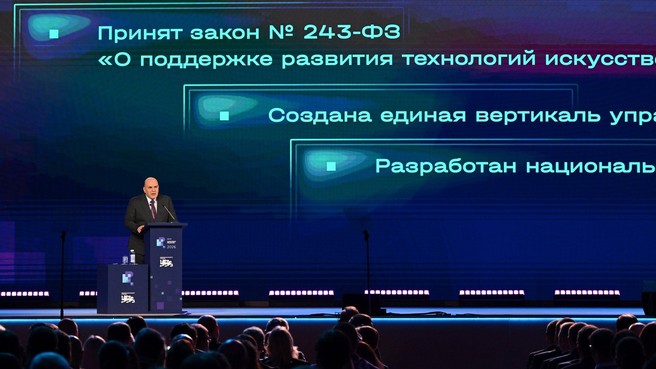
The recently adopted bill on AI support developed by the Government pursues this exact purpose. This law stipulates that Russian developers can have access to a broad range of assistance tools. Various data sources will be available for training foundation models.
Certainly, it is important for companies to switch to Russian-made solutions more actively. The choice is still theirs. But when it comes to critical infrastructure and other sensitive areas, the Government will decide when only our internal national foundation models can be used. There will be a transition period for companies to prepare for their implementation. This period should be used to create conditions for the long-term demand for Russian AI services and adapt the procurement terms with due account for the models’ status, quality and actual application scope while maintaining competition among market participants.
One more note. This year has become a time of active implementation of AI agents – programmes that can autonomously perform complex tasks. As the next stage, we will develop entire AI agent ecosystems that will integrate enterprises, suppliers, banks and services. The state and the business community need to work together to determine the limits of authority and responsibility for AI agents to ensure their predictable operation and prevent disruptions.
Extensive implementation of AI also requires readjustment of government procedures. It is essential that federal, regional and municipal bodies have access to AI solutions without having to develop their own capacities and seek additional funding.
Gostech is the platform that can provide best turn-key services as a single package. Obviously, they all must be made in Russia. I hope that companies will show more extensive involvement in this work.
Colleagues,
Truly breakthrough solutions that will change the face of the future are being created in Russia today, and they are already beginning to be actively implemented. This is the result of the joint efforts of business and the state.
I am referring, for example, to civilian unmanned systems, which are used in forestry, to monitor the environmental situation, to assist in search and rescue operations, in the agricultural sector and, in some regions, to deliver goods.
Driverless trucks are now appearing on our roads. Their mileage on all routes since 2024 has already exceeded 18 million kilometres. More than 100 highly automated tractor units are being tested. In Moscow,
a hundred driverless taxis are available for booking, and the number of delivery robots – rovers – has already exceeded 1,000 across the country.
There are also technologies for automating the transportation of goods and the operation of warehouses. Just ten years ago, such innovations existed only in designs and science fiction films, but now they are an integral part of our everyday lives.
The same applies to digital platforms. First and foremost, these are marketplaces and aggregators, which significantly simplify the purchase of goods and services. Last year, total online sales exceeded 20 percent of retail turnover, amounting to more than 13 trillion roubles. Of this, around 70 percent was accounted for by these platforms.
To illustrate the scale, I will cite just one figure: more than 8 billion orders were placed.
Among the 20 largest e-commerce markets, Russia ranks first in terms of growth rate and has held that position for the fifth year in a row.
Digital platforms are in demand not only in trade. They are being actively implemented across a whole range of areas – in industry, agriculture, transport , logistics, and many others. They are becoming a crucial factor in the resilience of the economy. It is therefore necessary to ensure their uninterrupted operation, taking into account the technological capabilities of enterprises and government agencies , so that the failure of a single cloud service or software component does not lead to the mass disruption of production and the provision of vital services.
Acting on the President’s instructions, the Government has already begun preparing strategies for the development of autonomous systems and digital platforms. We are counting on the full and active participation of the business community and experts in this work.
Colleagues and friends, much has been done to achieve our country’s independence from foreign products. We have our own language models, our own e-commerce platforms, search engines and browsers. The browser created by Yandex has become the most widely used in Russia, overtaking Google Chrome for the first time.
We also have video aggregators. The VK Video app, for example, has already been downloaded 100 million times, and more than 130 million people have registered on the national messenger, MAX.
Russian social networks are also highly popular. VKontakte has a monthly audience of 94 million users. The company is celebrating an anniversary this week, and I would like to congratulate the entire VK team on its 20th anniversary.
Our online cinemas, music streaming and e-book services have doubled their revenues over the past two years.
The RuStore mobile app store is now installed on 100 million devices.
All this confirms that we have created a fully-fledged digital environment.
However, the ubiquitous spread of electronic services has also presented us with certain challenges, namely cybercrime. To combat this, amendments to the legislation were drafted and adopted acting on the President’s instructions. As a result, the number of such crimes over the first eight months of this year fell by almost a third. This is an excellent result achieved through the work of our colleagues in this field and our law enforcement agencies.
A unified anti-fraud platform for online interaction between banks, telecom operators and digital platforms has also been established. This allows them to exchange data in real time, which makes it possible to suspend suspicious transactions and block the actions of criminals at all levels simultaneously.
We are continuing and expanding this work so that people can promptly report fraud and protect access to their user and bank accounts. This functionality must be implemented on the Gosuslugi [Public Services] portal.
Yet even this is not enough. Criminals have begun to use artificial intelligence more actively to imitate people’s voices, appearance and behaviour. Therefore, individuals must clearly understand when they are interacting with artificially generated content and that it cannot be trusted. Citizens need to be made aware of this.
Furthermore, AI agents are now capable of independently invoking services, altering records, initiating transactions and carrying out cyberattacks.
Combating such crimes requires the coordinated efforts of the entire information technology and information security industry. Only in this way can threats in the virtual environment be countered effectively.
The Ministry of Digital Development, of course, must also strengthen the protection of accounts on the Gosuslugi portal, which is already used by 120 million people. User data must be stored securely. The ministry must also develop additional conditions for logging in to the platform or for restoring access to it.
The Ministry of Digital Development’s programme of independent penetration testing of state information systems is already attracting thousands of independent researchers to assess the quality of their protection. The reward for finding a vulnerability on Gosuslugi now reaches one million roubles. This practice needs to be expanded.
Colleagues,
The results we are talking about today are the achievement of the national ICT sector, the professionals who develop solutions needed by our economy and citizens. The demand for them is backed by concrete figures.
The marketing of Russian software products reached 3 trillion roubles in the first six months of the year, which is nearly 30 percent more than in the same period last year.
About 20,000 companies have confirmed their accreditation and are using the relevant benefits. We see a return on these investments: every rouble of government support yields a return of nearly 2.50 roubles to the budget.
Our companies are increasing the production of corporate application and system software. In the past, this segment relied predominantly on foreign solutions.
We continue transitioning to national digital products for computer-aided design and production and process management. We have established 36 industrial competence centres. Our largest clients and developers are joining efforts in this strategic sphere, and the government is co-financing their expenditures.
The selection of the most important initiatives, which can receive government support, is underway. We are prioritising projects for basic industrial sectors that will rely on national AI-based solutions. Budgetary support can account for a substantial part of investment in them.
I would like to wish success to all those who will be involved in their implementation. I would also like to use this occasion to thank national companies which are investing their own funds into the development of such software.
It is notable that private business is actively contributing to training ICT professionals.
Accredited companies invest at least 3 percent of funds saved through benefits in industry-specific education, including on-site training, which allows students to test their skills in practice in various companies.
About a thousand relevant agreements have been signed with universities, colleges and schools, covering over half a million students and teachers. The total volume of investments has exceeded 10 billion roubles. This is our investment in the future of the sector, in ensuring that our companies have smart, responsible and professional personnel.
Of course, this is complementing the Government’s efforts to reinforce the sector’s human potential. We are implementing the Code of the Future project, under which 300,000 schoolchildren have mastered programming skills. Last year, they started studying robotics and AI. Seventy-five percent of the school graduates who attended these classes enrol in IT and engineering disciplines.
Nearly 215,000 students have been enrolled in these disciplines at universities this academic year.
We have launched new projects aimed at implementing a modern system of training world-class IT professionals. It is based on three principles: advanced training, close links with business, and focus on real-world industry tasks. Today, 52 universities are taking part in these programmes, 180 education programmes have been developed with the help of companies, and over 10,000 students have been enrolled in them this year.
They will become top-class AI engineers and developers of complex systems, the professionals who are highly sought after now.
I hope that business will continue to take an active part in their training. In this way, friends, you will train professionals for your teams and your sector, ensure the further development of your enterprises and lay the foundation for years ahead.
Colleagues,
Friends,
The forum provides an opportunity to discuss all issues in detail and to pool efforts for developing effective solutions and steps towards Russia’s technological leadership. This is the task the head of state has set for us.
The government, the business community, experts and members of the scientific community should work together to shape our digital economy. This means that the future development of our country, the key industries and the social sphere depends on how well we coordinate our actions. I urge you to keep moving forwards and achieve success together.
Thank you. Good luck with your work at the forum.
Alexandra Suvorova (anchor, Rossiya-24, moderator): I would like to give the floor to Deputy Prime Minister of the Russian Federation and Chief of the Government Staff Dmitry Grigorenko.
Dmitry Grigorenko: Good morning.
You know, I was listening to the results of the past year with the rest of the audience.
It has been exactly one year since our last meeting at this forum. All the figures are two-digit. These are your results.
I’m a little confused about the greeting, wondering how I should address you now. I wanted to address you as friends but looked at the figures and decided it should be “ladies and gentlemen.” Well, good morning, ladies and gentlemen. Welcome to this IT forum – your IT forum.
We have agreed to meet at the digital solution platform once a year to lock in the results of the IT industry. These are the key results we all share. Another reason to meet here is to discuss plans for the next year and beyond.
By the way, it is very convenient to hold the forum in October. Last year, we couldn’t make a decision about dates. October seemed suitable but summarising results in October didn’t sound right.
On the other hand, the entire community persuaded us that October is the best month. When we started preparing for the forum I realised why it is the best month. There is a reason why IT people are said to be smart.
Turns out, in addition to being smart, they are also shrewd. Because summarising results in October is great. Everybody is telling me that not all projects are finished but they still have a quarter to finish everything. What has been accomplished can be presented to the Prime Minister. He will see how awesome these projects are.
That doesn’t negate the great results and major achievements that this industry has shown, in two-digit figures. I should probably mention some figures that certainly impressed me.
I looked a few years back and noticed that in the past six years – don’t ask me why I picked six years, no particular reason – the IT sector’s contribution to the Russian GDP has doubled. One hundred percent increase in the past six years is remarkable, to say the least.
Mr Mishustin quoted some IT companies’ revenues. I looked closely at accredited IT companies, which include marketplaces, digital platforms, e-learning platforms, and so on.
They haven’t finalised the year yet, so I looked at six-month results. Their revenue amounts to 5.9 trillion but it has grown by almost 70 percent in the past three years, or over 20 percent annually.
By the way, when I talk to you, you often complain that it’s a slow growth. How much is fast growth? Thirty or forty percent? On the other hand, it is great that even with these figures, your ambitions say more, faster and better.
As for Russian-made software, we have created a registry of Russian software, as you well know. You have criticised and supported it – opinions vary. But currently, over 30,000 Russian solutions are included in this registry.
If we look at the past six years, the number of Russian IT solutions has grown five-fold. This factory is operating at full speed, so this revenue growth did not come out of thin air. You are truly creating successful and competitive Russian-made solutions.
And one more remark. You know, we like to compare and sometimes underestimate ourselves. The rest of the world has this or that better. But when it comes to IT products… As of last year, despite all the challenges that you rightly point out and export issues that you raise absolutely fairly, the IT sector added 15 percent in revenue in 2025. We expect no less this year.
The most important thing I would like to say is that everything that the IT sector does is always about quality, comfort and convenience. And I believe that the only downside of the IT sector is that we – or you – spoil, in a good sense, people with your products and it becomes very difficult to move back to working environments and lifestyles that used to be the norm before. Most importantly, everything the IT sector does is for the people, for humans. Millions of people can feel this impact in their lives.
I should mention telecommunications and the internet. Mr Mishustin quoted some figures in his report. Telecommunications and the internet are basic necessities today. We have become so accustomed to them and take them for granted that so much that when something switches off or fails, we become genuinely anxious and resentful, lamenting about the future.
By the way, I looked at our annual internet traffic. One person consumes 1.5 terabyte per year on average. Is it a lot or a little? So, I looked at the global statistics. The global average is 1 terabyte. Our people consume 50 percent more. I converted this figure into days. That equals 21 days, or three weeks. Every person in Russia spends three weeks online on average. Here they are, the free nights. As a matter of fact, this has become a lifestyle.
The second area is, of course, digital platforms. As of today – as you have seen from the figures – we are the world leaders in the growth and development of digital platforms, and more than 80 percent of people today buy something on these platforms every month.
I am not an active user of digital platforms, to be honest. I am still exploring the landscape to see what is available and how it all works. But it is undoubtedly convenient, genuinely user-friendly, and it allows you to buy whatever you want without leaving the comfort of your home.
And then, perhaps, the third such track, I would note, is cybersecurity. Our cybersecurity companies are today very likely – or perhaps not just likely – among the best in the world, because all their solutions are, in effect, tested immediately in live commercial operation rather than in a controlled trial environment. And that is precisely why today these are undoubtedly among the highest-quality solutions in the world.
The upshot of all this is as follows: everything that is being done amounts to key services for citizens. These results and the availability of these key services are your achievement. You have achieved this, and it is not for nothing that people say it is highly prestigious to be a Russian IT specialist.
It really is cool, because you can see the results of your work not only on a screen but in real life, here and now. I want to say a huge thank you, on my own behalf as well, for these results. And it sometimes really does seem as if, in some respects, not only is there no need to help you, but it is best above all not to get in your way, because you can do it yourselves and do it superbly.
I suggest, perhaps, that we now make a start. By way of concluding my remarks, I would like to say the following: this year we tried to structure our forum around your submissions, since it is no secret that the best services operate by default by having feedback built into the service and constantly responding to that feedback. We, naturally, have also established our own internal feedback mechanisms and, on the basis of your requests, arrived at the conclusion that at least five thematic areas are needed at the forum, and both the forum and the exhibition are built around these five areas. The business programme, naturally, is arranged in the same way.
The first area is artificial intelligence. Where would we be without it? Everyone understands it, and everyone knows best. We are now smoothly heading towards a world divided into two camps: either people love and adore artificial intelligence, or they fear and hate it. In short, it is all getting more and more complicated, but that makes the task all the more interesting.
The second is digital infrastructure. Lately we have somewhat lost sight of this, but none of our ideas can be implemented without it. This is an important area, and it should not be forgotten. Yes, we have separate programmes and plans, and this is the important thing that we must synchronise among ourselves, in terms of both strategy and action.
The third is digital platforms and services. The world is becoming, in effect, one big digital platform, and I do not know whether that trend will stop at some point or not. Moreover, this big, global digital platform is trying to get onto the mobile phone screen of each of us. Where the real world ends and the digital world begins is also a topic for a separate discussion.
The fourth is cybersecurity. I have already said that today cybersecurity is the absolute minimum that must be in place before one can even begin to talk about creating any IT project.
And lastly , IT specialists would not be who they are if there were not always something rewarding at the end: either a concert, a party, or an entertainment service. Something along those lines. And the last area is, of course, entertainment platforms and online learning. These are services thanks to which a person always knows what to do in their free time – as long as it does not work the other way round, with all of one’s free time given over to entertainment and no time left for work.
So, those are the five areas.
I ask the speakers to go through each of them carefully and to outline what has been done over the past year and what the further plans are. And, whatever the case, and this is not in the programme, it seems to me that this is, in the best sense of the word, your chance to showcase and present the results you have achieved. And our chance, a brief and small one, is to sit quietly in the hall with Maksut Shadayev and take pride in what you have done, and to think that perhaps we helped you here and that nothing would have happened without us. Although that is a joke; we understand perfectly well that you would have done all of this brilliantly on your own.
Well, I think that is all. I suggest that we begin.